01
Mounting to the roof
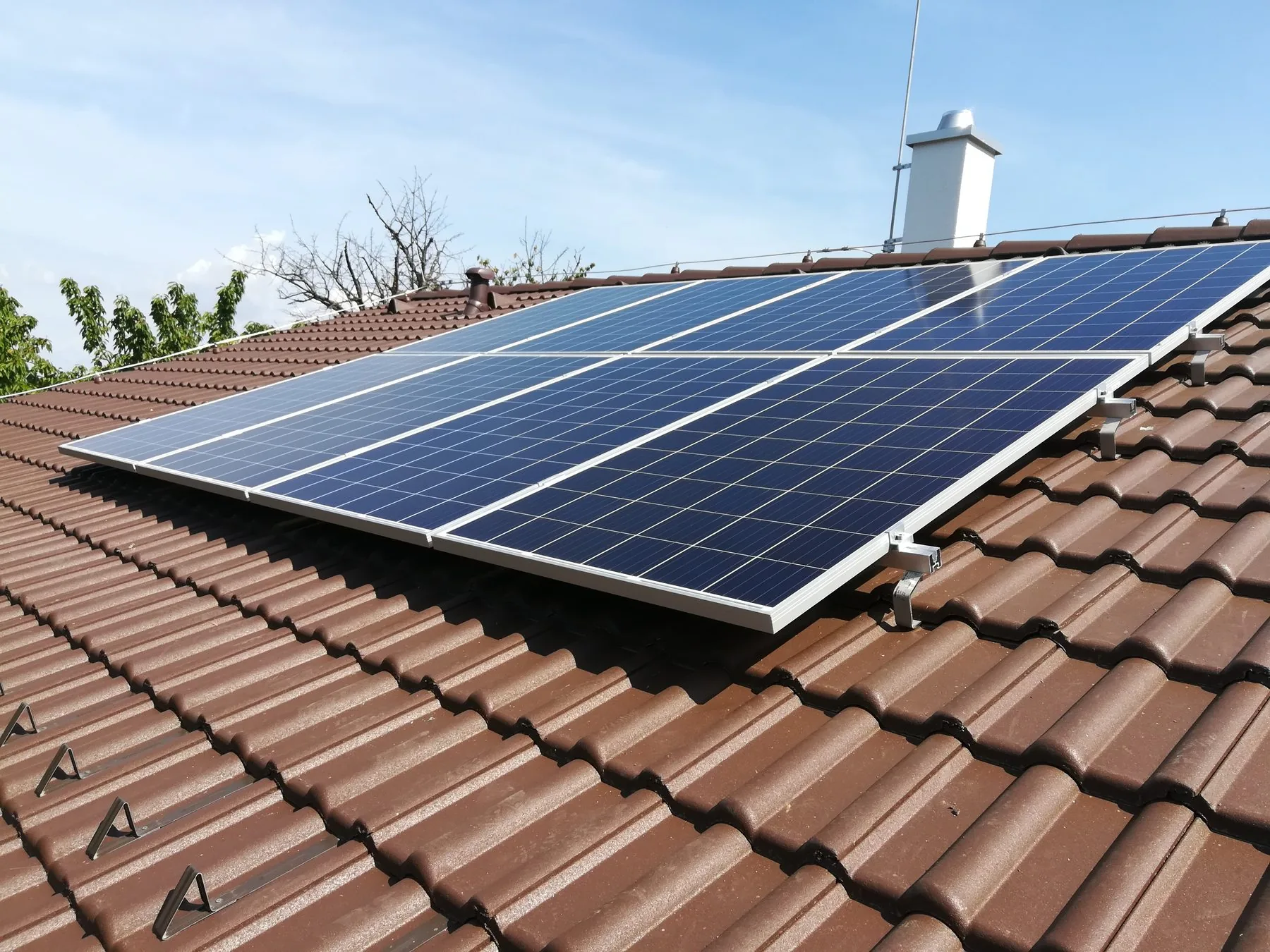
A frame chosen for the covering — tile, sheet metal, a flat roof. We anchor it so that the roof stays watertight and the frame carries the panels and the snow on them.

Service 05 all of Slovakia
Solar power for a family house, from the panels to the inspection report — we supply it and we fit it, so you are not assembling the job from several suppliers. Mounting to suit the covering, the DC side and the AC side, protection, surge protection and earthing. The surplus can go to a hot water cylinder, so what the roof makes stays in the house.
When you need it
05.01 · Roof
Tile, sheet metal and a flat roof are each anchored differently. We choose the frame for the covering and for what the roof carries once snow is on it — and so that it is still watertight when we leave.
Pitched and flat roofs
05.02 · Wiring
Panels strung together, an isolator, protection and the run to the inverter, then the AC side into the consumer unit. The DC side is live whenever there is light on the panels, which is why it has an isolator of its own.
Isolator protection consumer unit
05.03 · Hot water
The surplus that would otherwise leave for the grid can go to the element in a hot water cylinder. We install panels together with a cylinder — it is the simplest way to use what the roof makes.
Panels and a hot water cylinder
Scope
01
A frame chosen for the covering — tile, sheet metal, a flat roof. We anchor it so that the roof stays watertight and the frame carries the panels and the snow on them.
02
Panels strung together, a DC isolator, protection and the run to the inverter. No breaker in the house switches the DC side off: it is live whenever there is light on the panels, so it gets an isolator of its own within reach.
03
Into the consumer unit, with protection, an RCD and surge protection. The board has to have room for the array; where it has not, it is dealt with along with replacing it.
04
The frame and the panel rails belong in the bonding, and the installation gets surge protection on both sides. Panels sit at the highest point of the building, so it is also the moment to look at the lightning protection.
Outcome
What you hold in your hand when we leave. Four things you can check without us.
Common questions
Both. On a pitched roof the frame goes through roof hooks into the rafters and the covering goes back so the roof stays watertight; on a flat roof it is a ballasted or an anchored frame. The covering decides, and so does what the roof carries with snow on it — which is why this starts with looking at the roof rather than with ordering panels.
Yes. The frame and the panel rails belong in the protective bonding, and the installation gets surge protection on the DC side and the AC side alike. Panels sit at the highest point of the building, so it is also a good moment to look at the lightning protection — where the roof has none, or the one it has no longer does its job, we build it.
Yes, and it is the simplest way to use what the roof makes: the surplus that would leave for the grid goes to the element in a hot water cylinder instead. We install panels together with a cylinder — that is exactly what is in the photographs from our own job.
Yes, if you want one — it is not part of every system. Without a battery the simplest use for the surplus is heating water; with one, part of what the roof makes can be kept for the evening. A battery has its own protection and isolation and belongs in the initial inspection like the rest of the installation. Whether it pays in your case depends on how much electricity you use during the day and how much in the evening, and we go through that at the survey.
We prepare the documents: the initial inspection report and the installation paperwork the distribution operator asks for. The connection application itself is filed by the owner of the supply point, which is you — it is tied to your supply point and to your connection contract. We tell you exactly what goes where, so it does not come back for more.
Yes. A new installation is checked before it is put into service by an initial inspection to STN 33 2000-6, and you will need the report for the distribution company as well. We do both halves, so there is no inspector to find afterwards — the report is handed over with the installation.
Advice or a call-out
Need your installation checked?
0902 481 461Tell us what is happening, or what needs inspecting. We agree the scope, the price and the next free date on the phone. If you cannot get through, we are on a job and will call you back.